Categories
Citizenship Front Page LGBTQ+

The Interfaith Center to Celebrate Coming Out Day

OXFORD, OHIO — The Interfaith Center at Miami University will be hosting a Coming Out Day Celebration on October 4th, 2024, from 6:00pm – 8:00pm (Doors at 5:30pm) at 16 S. Campus Avenue, Oxford, OH 45056. This event will feature:

  • Free refreshments!
  • An opening interfaith prayer
  • Drag performances by P.H. Dee (https://phdeedragqueen.com/)
  • Performances by members of the Cincinnati Men’s Chorus(https://www.cincinnatimenschorus.org/)
  • An art exhibition and art talks by Saad Ghosn (https://sosartcincinnati.com/)
  • A workshop led by Interfaith Photovoice (https://www.interfaithphotovoice.org/)

We, The Interfaith Center, as with all our programming, seek to unify people in our Oxford, OH, community. We are delighted to host this free community event on 4th October, to show our admiration, love and support especially to the LGBTQ+ community in Oxford, OH, and everywhere, for their journey and their courage in coming out and in just wanting to be themselves. While we celebrate their courage, we believe that no one should have to face a difficult time in their families or in society as they are going through their personal journey in coming out.

This event is an attempt by The Interfaith Center and all our partner organizations to honor the journey of self-discovery and the freedom of being true to oneself.  We all belong to one global human family. We hope this event is one more attempt by us to make everyone realize that we all belong to this one large human family, and we all have to be there for one another always.

To attend, please register for free at:
https://form.jotform.com/242053259860356
Categories
Art Front Page Prayer Religion

Cincinnati Leader in Interfaith Work Publishes Book on Sacred Spaces

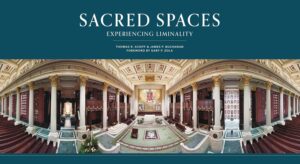
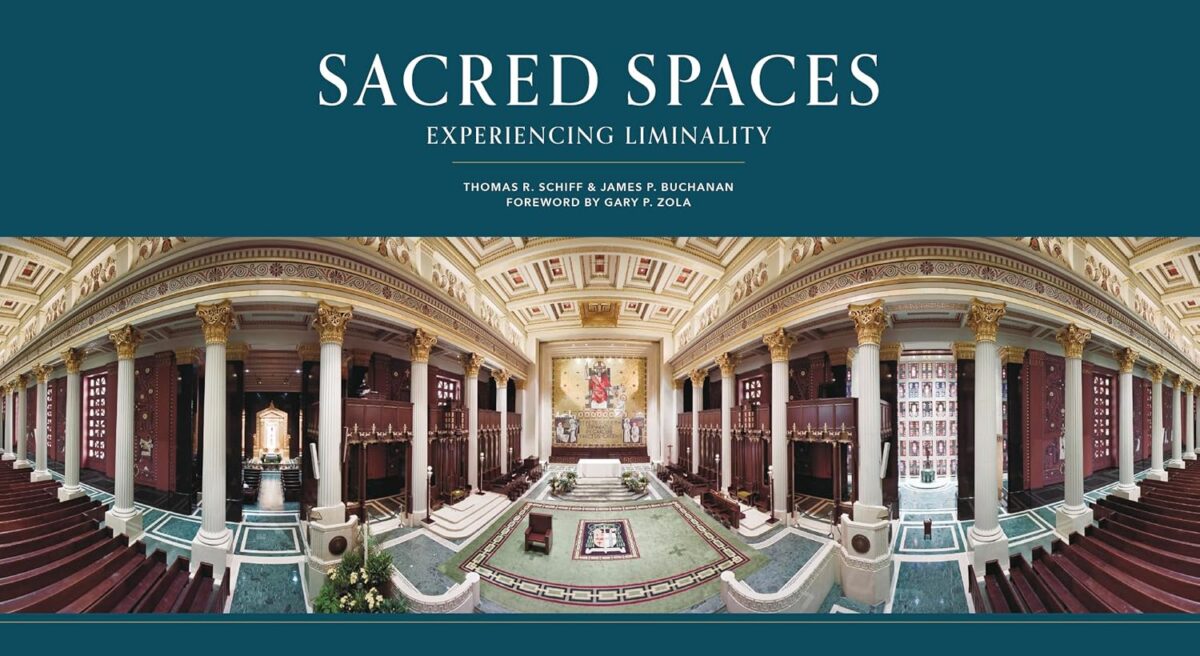
Sacred Spaces: Experiencing Liminality

By Thomas R. Schiff and James P. Buchanan

Foreword by Gary P. Zola

The photographs in this book were taken over several years and the project originated when Thomas Schiff approached James Buchanan about working together. At that time, Buchanan was a professor and the Executive Director of the Edward B. Brueggeman Center for Dialogue at Xavier University in Cincinnati. One of the areas of focus of the Center’s work was interfaith dialogue and collaboration. Based on some initial conversations, Tom and James  decided to produce a book of panoramic photographs of sacred spaces—old missions, churches, cathedrals, synagogues, mosques, and temples—across the United States, accompanied by an essay. Tom already had some photos but subsequently embarked upon a multi-year journey around the U.S., producing this stunning collection of photographs.

All proceeds from the sale of this book go to support nonprofit interfaith work. 

Those interested in buying this book can purchase a copy through the publisher or Amazon.

Categories
Cincinnati Peace Religion

Friends for Good Leader Reflects on Summer Camp for Interfaith Youth

By Adam Hayden

Cincinnati, Ohio — This year we had another beautiful Interfaith Harmony Camp experience. Twenty students representing five different faith traditions came together for a week of games, learning, and lots of snacking.

One of the highlights of the week was being at the Hindu Temple of Greater Cincinnati. It was so beautiful to see the Deities. They were adorned with amazing outfits and divine stories. It was inspiring to see and experience. That was upstairs in the Holy space. Downstairs, something very different took place.

There was one moment that day that stood out above all the rest. It was when one of our Episcopal teens interviewed one of our Hindu teens. During the interview, the crowd (i.e., the rest of camp) asked follow up questions. The day before, we did something similar. A Jewish teen interviewed two Muslim teens. Both of these interviews were important to what we do at Friends for Good. It is so powerful when teens talk to teens about their identities and their experiences. They weren’t up there representing their entire religion on their backs. They were representing their stories and their religion is one aspect.

It was beautiful to experience. To sit in the back and listen to the teens talk to each other and take questions from the group was exactly what we are about at Friends for Good.

I don’t like what’s going on in this world. I don’t like war. I don’t like how they start. I don’t like how they escalate. I don’t like how it affects people from death to injury to trauma to people not being friends over it thousands of miles away and several continents apart.

However, I do like peace. I like when kids come together and show us a different approach. I like how they look at each other as potential friends even if they don’t know each other, especially when they don’t know each other.

I loved seeing our teens talking about their lives with one another just after they tie-dyed t-shirts, ate cereal for lunch, or played the “trash can game.” During the course of the week, they came together to play games, eat delicious food, and learn about each other. And they did it so well.

Thank you students. You always inspire me.

Categories
Cincinnati Front Page Religion

Festival of Faiths Returns to Cintas Center This August

By: Jan Armstrong Cobb

Cincinnati, OH — “The best way to accept diversity of religion is to be educated about all the different religions.” To further this vision, the annual Cincinnati Festival of Faiths will begin on Sunday, Aug. 25 from 12 – 5 PM at the Cintas Center, continue with online programming, and culminate with a Peace Walk on Aug. 29 from 6 – 8 PM. The festival is a celebration of all faiths where we can have fun and learn from one another.  This is the seventh year we have gathered at the Cintas Center.  Nearly 2,000 people come to learn about the many religious organizations that are represented. Entertainment includes choral groups and dancers from many cultures. The exhibition features over 60 organizations representing 13 world religions and over 30 faith traditions. It is the flagship program of EquaSion and is open to the whole community. Admission is free. 

EquaSion is a non-partisan civic organization founded upon interfaith dialogue that works to develop educational and community service programming to foster greater understanding, respect, compassion, inclusion, and engagement for all people and faith communities in Greater Cincinnati and beyond. Living our mission everyday through compassion and collective action, we engage people of all faiths to discover their shared humanity and spirituality, and to work together for an equitable and just community for everyone.

The Sunday programming includes breakout sessions about compassionate conversations, sacred connections, spiritual meditations, and Faith Communities Go Green. Following the Sunday celebration, there will be virtual sessions for these topics as well. 

Thursday is our second Peace Walk. Held at Ault Park from 6-8, we will gather to march together, sing, and enjoy ice cream. The Peace Walk is open to the entire community and we hope to draw many who want to make their personal and communal statement about the need for peace in our world.

For more information about these events, please see the EquaSion.org website.

Categories
Cincinnati Environment

FCGG included in grant applications!

By Joanne Gerson

Cincinnati, OH — The City of Cincinnati is applying for a grant opportunity for nonprofits, including houses of worship (HOW) that serve disadvantage communities and invited FCGG to be a part of their grant application. They selected 8 HOW participating in our Energy Efficiency Initiative that met the grant criteria. If awarded, this grant will provide funding for energy assessments, insulation, HVAC systems, and lighting, and more, to improve the energy efficiency in buildings. This presents a significant opportunity for faith communities to receive funding to help with energy efficiency upgrades in their facilities and create jobs for minority business in the process.

This is not the first and will likely not be the last grant opportunity to come our way. Recently both OKI and EquaSion submitted grant applications that include funding for HOWs through FCGG. Another interesting proposal we are looking at may lower the cost of electricity, solar installations, or energy efficiency upgrades through purchase agreements in collaboration with a group of HOWs to take advantage of economies of scale.

We need to be prepared when the opportunity presents because the amount of time we are given to respond is generally very short. Here are two things you can do right now. Go the ‘Take Action’ tab on our website at FCGG.org/ to find the section for the Energy Efficiency Initiative. If you, or a member of your congregation, never completed the EEI Survey, please complete it. If your congregation already completed the Survey, please send us 13 consecutive months of utility bills for your facility. The instructions for getting your utility bills are in the EEI section on the FCGG.org website. Send them to Ken and for questions also, please write to Ken at Facilities@fcgg.org and Joanne at info@fcgg.org/. We do not share your information with the public without your permission. Together, we can help you save money to use for your important community work and reduced pollution to better care for our common home.

Categories
Cincinnati Environment

Fifth Christian Church Energy Assessment and Energy Assessor Training

by Donna Turner

Cincinnati, Ohio — I enjoyed our energy assessor training and the energy assessment. Fifth Christian had our energy assessment Thursday, February 15, 2024. As people streamed in that evening, I encouraged them to have snacks as we set up. We ran into a rash of technical issues; Ken was supposed to come but couldn’t attend in person and would present his part on Zoom. Then Justin had to come in from Columbus and was a tad late. We had 18 people. A few church members joined out of curiosity, so almost everyone was new but our technical issues brought us together. Everyone was focused and sharing ideas and when we prevailed and the training was completed, we then broke into groups to do the energy assessment. It was interesting to see my church through the eyes of the guests and to answer questions about the mundane energy users, overhead lights, stove in the kitchen, thermostat.

I recommend that all churches participate in the energy assessment program. The 13 consecutive months of energy bills are easily downloaded from the energy company website. They are needed to determine the projected potential savings. We benefitted from the fellowship and we will never look at our overhead lights the same way. There were lots of benefits to making the changes and cost was central but not even the most important.  For instance, we have bulbs that are burned out, with the current system we are told that we are paying for the bulb as if it is being used. They are now a part of our plan for better stewardship over the blessing of having a house of worship.

Categories
Citizenship Front Page Peace Religion

A Reflection on “How to Navigate Religious Differences in Our Divisive World”

The Interfaith Center at Miami University
Geneva Blackmer, Interim Director

On May 17 th , 2024, at 2:00pm ET, the Interfaith Center at Miami University in Oxford, Ohio welcomed author Deborah Levine for a virtual presentation titled “How to Navigate Religious Differences in Our Divisive World”. This presentation, based on the content in her book, “Religious Diversity in Our Schools” drew attention to current cultural trends exasperating fear, anger, and frustration in our local communities. She connected the rise in such tensions to the increased spread of information and misinformation online, the lack of separation between religion and political elections, growing international conflicts such as the Ukraine-Russia and Israel-Hamas wars, and policy changes across university campuses regarding DEI activities. Levine suggested that efforts to promote religious literacy on campus must also inspire goodwill and prioritize common values. This includes the incorporation of multi-faith calendars which observe all major religious holidays, the recognition of sacred food practices, the importance of language, and an understanding of important life cycle events. She recommended unifying diverse groups through mutual concern for community issues, such as participating in service projects at food banks and homeless shelters. Further, she stressed the importance of honoring these works by holding award ceremonies on campus for those leading initiatives with meaningful impact.

Most significantly, she recommended strategies for countering culture clashes on campus that can lead to hate speech, violence, and vandalism, encouraging participants to not blame individuals for international conflicts and to engage in ongoing learning. She suggested a model for engaging in constructive dialogue around the Middle East through the creation of an Abrahamic sub-committee, comprised of faculty and students. She stressed the importance of a limited number of participants, and the creation of a reading list and appropriate guidelines for dialogue. The group should begin with low impact themes and gradually progress towards conflict-oriented themes as trust is built. With time and growth, opportunities for broadened dialogue participation may be cultivated. Increasing polarization has led to dangerously high hate incidents of Islamophobia and Antisemitism across North America, with reports from the Council on American-Islamic Relations (CAIR) and the Anti-Defamation League citing an increase of 300-400% since October 7th. It is more important now, than ever, that interfaith leaders do their best to mitigate tensions on our local campuses and communities that can lead to religiously motivated violence. To participate in upcoming Interfaith Center programs, please visit https://www.oxfordinterfaithcenter.org/.

Categories
Cincinnati Islam

Ramadan 2024

“As one deprives the body, the soul gains purification and strength in a manner pleasing to God, ultimately fortifying an individual’s character for the year to come.”

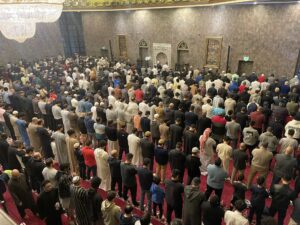
Men in mosque stand in rows, facing toward away from the camera, so only backs are visible.
Muslims gathered at the Islamic Center of Greater Cincinnati (ICGC) for Ramadan nightly congregational prayers with recitation of the Quran and prayers for peace.

Of the 2 billion Muslims across the world, about 40,000 Muslims Americans reside locally, and they recently observed the holy month of Ramadan (from March 10-April 9, 2024).

Ramadan is one of the five pillars of Islam, alongside Declaration of Faith, Prayer, Charity, and Hajj (pilgrimage to Mecca). It falls during the ninth month of the Islamic Calendar, which is based upon the lunar calendar. Because the lunar year is shorter than the Gregorian calendar, Ramadan starts 11 days earlier each year.

During this month, Muslims observe a month of consecutive fasting (29 or 30 days) during which they abstain from food, drink (including water), and intimate relations from dawn to sunset. All adult Muslims – men and women who have reached puberty- are required to fast, except those with chronic illnesses, advanced age, pregnancy, menstruation, and those traveling.

The purpose of fasting is not to impose hardship, but rather to fulfill a religious obligation and gain closeness to God. It is a month of increased prayers, recitation of the Holy Quran, charity, service, and appreciation for God’s countless blessings.

Ramadan is also a time of community building. Friends and family often break fast together and gather at mosques for special congregational nightly prayers. During these prayers, which can last 1 to 2 hours, the entire Quran is recited over the course of the month. Muslims often stay up during the last ten holiest nights of the month, increasing their prayers and supplications.

Ramadan ends with the holiday of Eid-ul-Fitr. It is a time of joy and festivities for Muslims globally. After attending morning prayers in the mosque, it is a day of celebration with beautiful attire, gift exchange, scrumptious meals, and time well spent with friends and family.

Unfortunately this Ramadan and Eid has been unlike any other for Muslims across the globe. The collective pain, against the backdrop of witnessing 6 months of indiscriminate violence and unimaginable atrocities against an entire population in Palestine, has transformed Muslims’ prayers into a new dimension of urgency and desperation. As the month ended, there is an ongoing supplication for God’s Mercy and lasting peace in the region and beyond.

Ameen!

(For more information about Islam, Muslim Americans, or a tour of the Islamic Center of Greater Cincinnati, please visit www.icgc.us)

Categories
Art Cincinnati Front Page Judaism

The Skirball Museum Presents New Exhibit

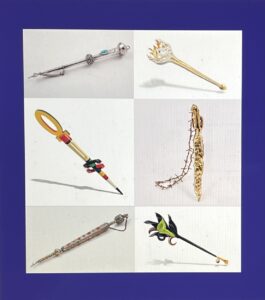
Six images of Yads, Torah pointers, are arranged on a purple background.
Six Yads from The Barr Foundation Collection of Torah Pointers

The Skirball Museum on the historic Cincinnati campus of Hebrew Union College-Jewish Institute of Religion is pleased to present The Guiding Hand: The Barr Foundation Collection of Torah Pointers, on view through Sunday, July 28, 2024.

A Torah pointer is often called a yad, the Hebrew word for hand, because a pointing finger was characteristically a prominent feature of early examples. Pointers are tools exclusively used to keep one’s place in the Torah scroll, the central text of the Jewish faith, which is densely hand-written in Hebrew. The yad also assists in protecting the integrity of the quilled letters and the delicate vellum of the Torah scroll. For hundreds of years, Jews used simple tapered wooden sticks to point the way through the text of the Torah, or Five Books of Moses.

Virginia resident Clay H. Barr began acquiring Torah pointers nearly

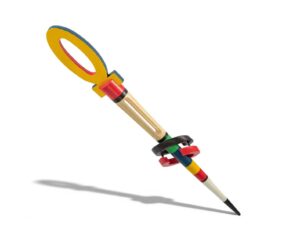
Multi-colored yad, made of painted wood
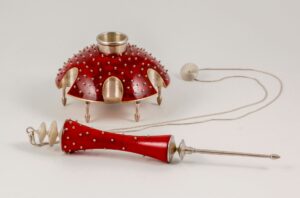
John Okulick (American b. 1947), Cosmic Wand, 2020, painted wood. Photo courtesy of the Barr Foundation Collection of Torah Pointers

30 years ago in memory of her late husband, Jay D. A. Barr. Her collection of more than 250 Torah pointers includes antique and contemporary examples that represent the full range of elaborate historic forms. Barr’s yads, 130 of which are on view in this exhibition, range in length from a few inches to nearly two feet. While some are made from traditional materials such as wood, silver, gold, or ivory and date to the 18th century, Barr has reached beyond Jewish artisans to commission Torah pointers from artists who fashioned them from Lucite, glass, beading, concrete, and even a skateboard among other unconventional materials.

Yads by Tobi Kahn, Wendell Castle, and Albert Paley are among the commissioned pieces that appear in the Skirball show. Because yads have no design restrictions, the design possibilities are endless.

As a complement to The Guiding Hand: The Barr Foundation Collection of

Two-piece yad made of silver metal with red decorative coating
Jennifer Banks (American b. 1966), Torah Pointer and Stand, 2007, pointer: ebony, copper, silver; stand: copper, silver, multiple layers of resin mixed with red pigment. Photo courtesy of the Barr Foundation Collection of Torah Pointers

Torah Pointers, the Skirball is offering an online exhibition of its own yads, which includes examples by Stuart Golder, M. Goldsmidt, Ludwig Yehuda Wolpert, and Fred Fenster.

Upcoming public programs in conjunction with the exhibition include Make Your Own Yad! with Cincinnati artist Judith Serling-Sturm on Sunday, May 5; Lunch and Learn with curatorial consultant Abby Schwartz and collections manager Sheri Besso on Thursday, June 6; and Functional and Fabulous: The History and Artistry of the Yad with Abby Schwartz on Tuesday, July 16. To register, visit https://csm.huc.edu,  email awheeler@huc.edu, or call 513.487.3231.

Transcending religious iconography, this dazzling exhibition is certain to appeal to all who appreciate the beauty and craftsmanship of fine art.


Categories
Cincinnati Citizenship Judaism Prayer Religion

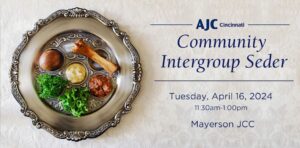
American Jewish Committee Hosts 31st Annual Community Intergroup Seder

Cincinnati, Ohio — The American Jewish Committee (AJC) is proud to host its 31st annual Community Intergroup Seder, set to take place on April 16. This cherished tradition extends an open invitation to members of the community, fostering unity and understanding through the tapestry of the Passover ritual. Rooted in the commemoration of the exodus from Egypt and the renewal of spring, the Seder, meaning “order” in Hebrew, transcends cultural boundaries, welcoming all to partake in its timeless narrative.

At the heart of the Seder lies the Haggadah (Passover script), serving as both a guide and a focal point for participants. This booklet navigates the journey from Egypt through the harrowing plagues, culminating in the embrace of freedom. Symbolism intertwines with history as each page unfolds, illuminating the significance behind the rituals and traditions.

What began as a modest gathering of 25 individuals has blossomed into a gathering of over 150 attendees, encompassing elected officials, esteemed community leaders, clergy, and a notable contingent of private and parochial high school students. The Seder, among the most inclusive of Jewish holidays, extends its embrace beyond the confines of tradition, as families extend invitations to non-Jewish friends, inviting them to partake in this pivotal moment of Jewish history.

The Community Intergroup Seder serves as a beacon of storytelling, a public testament to our shared heritage. Against the backdrop of hospitality and delicious cuisine, attendees unite in the retelling of our collective journey, affirming bonds of friendship and understanding. Through this communal celebration, we not only honor our past but also pave the way for a future of harmony and mutual respect.

We invite you to learn more and grab your seat today!