Categories
Cincinnati Citizenship Environment Ethics Front Page

Investing in the Future Means Investing in Sustainability

By: Kathleen Sellers

Cincinnati, OH – On February 26, Faith Communities Go Green (FCGG), an initiative of the Green Umbrella, hosted the webinar Save (for) the Planet: Know the POWER of your Dollars, which was attended by more than thirty people. This educational event was designed to teach participants how to make Earth-friendly choices with their money, by exploring how banking choices impact the planet and climate change. Ditte Wolin, Member of TH!RD ACT, Ohio Working Group; Howard Fischer, Steward and the Chief Evangelist at Gratitude Railroad; and Kyle Väth, Parishioner at Christ Church Cathedral Episcopal Church engaged in a conversation in which they shared insights from their decades of combined experience with sustainable investing, divestment, and collective action concerning sustainable finance. Becca Desai, Co-Leader of FCGG Education/Lifestyles Working Group, moderated the conversation. 

While each speaker had distinct experiences and training in this topic, they agreed that thoughtful engagement with the banking system is one of the most impactful ways that we can individually and collectively live out sustainable values. “Every dollar we spend impacts the environment,” explained Howard Fischer, an emeritus leader in capital management, which is why people should be intentional that their spending can and should “best serve your values and needs.”  One key way that people can do this is by investing in companies that share their values for sustainability. Fischer explained that there are financial management companies that specialize in impact investing and sustainable investment, and many firms today offer  investment portfolios that do not include any fossil fuel companies, for example. 

Investing is not the only way that presenters recommended aligning their money with their values for sustainability. Kyle Väth described how the choice of where to bank, what credit card to use, and even where to purchase auto or home insurance can have significant impact on the environment, because each of these financial tools and institutions uses our money for some “downstream” purpose. That is, they profit by investing our money in other companies, companies which may or may not be sustainable. If we are deliberate about the financial institutions we work with we can be more confident that our money is supporting a sustainable future. The choice to act so deliberately is necessary in our capitalistic society. As Väth asserted, “Where there is profit, we need prophets.”

Both Väth and Ditte Wolin were clear that while our individual actions do matter, working together with others increases our impact. Wolin, who is active in an organization called TH!RD ACT, which mobiles citizens over 60 to fight for climate justice and democracy, reflected, “What do you tell your grandkids [you did to respond to climate change]?” One clear answer, she suggests, is to move your money. But by working with TH!RD Act, Wolin shared how collective action among concerned citizens can encourage larger financial institutions to move their money too, like when a petition from tens of thousands of concerned citizens prompted the new CEO of Costco to reconsider their ties to CitiBank. 

Väth brought the idea of collective action even closer to home, by reflection on how congregations can also take action to make more sustainable investments. And he explained, people of faith should address this issue because climate change is indirectly causing harm to the most vulnerable in our society. If we care about the vulnerable, and care about future generations, we need to reckon collectively with the fact that “money is where the power is.” Väth recommended several steps that congregants can take to start moving their faith communities toward more sustainable action, beginning with forming a “Green Team.” 

Anyone interested in exploring this idea further, or wanting to learn more about sustainable investing, divesting, and reinvestment strategies can begin with this Program Toolkit, provided by the presenters at this event.  You can also get more engaged in sustainability work in the Southwest Ohio region by visiting the Faith Communities Go Green website: https://fcgg.org/.
Categories
Environment Prayer Religion

Congratulations to Sr. Cj Willie!

From Faith Communities Go Green

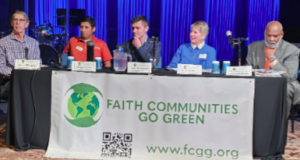
Cincinnati, Ohio — Sr. Cj Willie has been invited to be a panelist on The King Abdullah bin Abdulaziz International Centre for Interreligious and Intercultural Dialogue (KAICIID) on a webinar entitled Beacons of Hope: “Sharing Good Practices of Faith-Based Initiatives on Environment and Climate Change”. KAICIID , is an intergovernmental organization working in partnership with the United Nations to promote interreligious and intercultural dialogue to prevent and resolve conflict. The webinar will be held on February 7 th to celebrate World Interfaith Harmony Week (details below). World Interfaith Harmony Week provides a platform, in February each year, to bring together mutual understanding and interreligious dialogue to promote harmony between all people regardless of their faith. The ‘Beacons of Hope’ webinar will explore good examples and case studies of faith-led activities/ initiatives on environmental protection, the role of faith in environmental protection, as well as the role of faith in the mobilization of local communities in fighting against climate crisis. We are honored that Cj will present Faith Communities Go Green to the world as an example of a successful platform to partner with local faith communities to reduce the risk of catastrophic climate change.

How to Attend:

Wednesday, February 7, 2024, at -time- ET: Beacons of Hope: Sharing Good Practices of Faith-Based Initiatives on Environment & Climate Change,’ a virtual program.
As part of World Interfaith Harmony Week, the ‘Beacons of Hope’ webinar will explore good examples and case studies of faith-led activities, projects, and initiatives on environmental protection, the role of faith in environmental protection, as well as the role of faith in the mobilization of local communities in fighting against climate crisis. During the panel presentations, Sr. Cj Willie will present Faith Communities Go Green to the world as an example of a successful platform to partner with local faith communities to reduce the risk of catastrophic climate change.
Registration Required.

Categories
Cincinnati Front Page History Prayer Service

Homeless Coalition Hosts Memorial Service

Cincinnati, Ohio – For many, this time of year is full of celebrations. Jews celebrate Hanukkah, when Jerusalem was recovered and the Second Temple rededicated. Christians celebrate Christmas, the commemoration of the birth of Jesus. And Pagans celebrate Yule, when the Winter Solstice happens, marking the coming of longer days and shorter nights. For those struggling with homelessness, however, these long and cold nights are not times of celebration but deep struggle. For this reason, the date with the longest number of nighttime hours each year is also known as Homeless Memorial Day and is considered by many a national day of mourning.

Each year in Cincinnati, numbers of unhoused people die from exposure to the winter weather. That is why each year, The Greater Cincinnati Homeless Coalition hosts a memorial service on the longest night of the year, Winter Solstice, to remember those unhoused residents of the city who passed away. “Everyone is welcome.  You can come and speak, you can sing, you can be quiet and listen.  Come in any way that is meaningful to you” wrote The Homeless Coalition in an invitation for the event. 

This year, 175 names were read at a candlelight service held in Washington Park, Over-The-Rhine. This list was compiled by friends, family, and organizations around the city that knew and cared about these residents. The service was attended by dozens of people, including from many faith communities around the city.  

Whether or not you attended this year’s service or know those affected by homelessness, there are lots of ways that you can offer support. In Northern Kentucky, the Emergency Shelter of Northern Kentucky welcomes material and cash donations, as well as volunteer support. Visit their website to learn more: https://emergencyshelternky.org/

In Cincinnati, The Homeless Coalition invites community partnerships, donations, and subscriptions to Street Vibes, a newspaper written and distributed by those affected by homelessness. They also host regular  community-engagement meetings, where you can learn how to get more involved. Please visit their website to learn more: https://cincihomeless.org/

Categories
Cincinnati Environment Front Page Service

Cheryl Hutchins Named New Program Manager at Faith Communities Go Green

November 27, 2023

Cincinnati, OH — The FCGG Energy Efficiency Initiative is marching forward! Over 50 faith communities completed survey forms and answered questions about their facilities’ needs for energy upgrades to lower utility bills and pollution emissions.  We have great news!

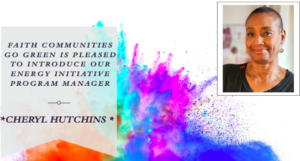
Cheryl Hutchins, a Community Advocate with over 25 years of experience teaching and training in clinical, community, and classroom settings, has over a decade of management experience mostly in non-profit/ community-based organizations.  Ms. Hutchins will contact participating Faith Communities to set in person meetings.

More volunteer opportunities for the FCGG 2024 Energy Efficiency Initiative Energy Assessment Training. Thank you to the many people who volunteered for the first Energy Assessment training. Our first training session is on Thursday, December 7 from 4 to 8 PM.

It’s not too late to join this training session, but you must join before midnight, December 5, 2023. For the location, directions, and to join, please contact our Facilities Working Group leader, Ken Wright, at facilities@fcgg.org.

There will be a second session in January, details to be announced. If you would like more information and/or wish to participate in the January training session, please contact our Facilities Working Group leader, Ken Wright, before Dec 31, 2023, at facilities@fcgg.org.

Check out Faith Communities Go Green new quarterly Newsletter under the Media tab at FCGG.org

Categories
Cincinnati Front Page International Collaboration Judaism Religion

A Shift in Focus: AJC’s Annual Thanksgiving Diversity Lunch Takes a Hiatus

Cincinnati, OH — The Cincinnati office of the American Jewish Committee (AJC) has made a significant decision regarding its annual Thanksgiving Diversity Lunch, opting not to host the event this year. This decision is rooted in the evolving nature of AJC’s priorities and a newfound interest in hosting annual fall events and collaborative programs that align with global affairs, diplomacy, or relevant issues of concern to AJC and its intergroup partners.

For many years, AJC’s Thanksgiving Diversity Lunch has been a staple in Cincinnati, bringing together a diverse group of individuals from different faiths and backgrounds to celebrate unity, diversity, and gratitude. The successful event, formerly hosted by then AJC Directors Cathy Heldman and Barbara Glueck, has been a meaningful expression of AJC’s commitment to fostering interfaith dialogue, understanding, and cooperation.

In place of the Thanksgiving Diversity Lunch, AJC Cincinnati is excited to invite the region’s interfaith leaders and friends of AJC to attend its annual Community Intergroup Seder, to be held during lunch hours on April 16, 2024. This event seeks to intersect the story of Passover with the greater Cincinnati community, emphasizing the universal themes of freedom, liberation, and unity that are at the heart of the Passover narrative.

While the Thanksgiving Diversity Lunch has been a cherished tradition, the decision to pause the event reflects AJC Cincinnati’s commitment to adapt and meet the evolving needs of the community and the world. By focusing on initiatives and programs that navigate global affairs, diplomacy, and relevant issues, AJC hopes to continue making a meaningful difference in the pursuit of a more just, equitable, and peaceful world.

On that same note, AJC, in partnership with the Cincinnati JCRC and sponsored by the Jewish Federation, is proud to be launching the Cincinnati Abraham Accords Collective (CAAC). The CAAC is a first-of-its-kind initiative that aims to establish lasting connections between emerging business and civic leaders in Cincinnati and the Middle East North African (MENA) region, with a focus on economic integration and leveraging U.S. innovation in support of the Abraham Accords goals. In Spring 2024, the selected in-person delegation with leaders from Cincinnati and the MENA region working in fields like health, clean energy, and food and water security, will gather in Cincinnati. This gathering offers a unique opportunity to collaborate, network, and deepen engagement while positioning Cincinnati as a model for global exchange, promoting international cooperation and more. All costs for Cincinnati participants will be covered, and the program will include strategic workshops, meetings with local leaders, and community events. To participate, individuals of all backgrounds are encouraged to learn more and apply. Please contact Justin Kirschner, Regional Director of AJC Cincinnati, for more information.

Categories
Cincinnati Environment Job

Faith Communities Go Green Seeks Volunteers and Community Support

Volunteers Wanted for Earth Care Initiative

📣 Calling all volunteers! 🙌

Are you passionate about making a positive impact on our environment and helping congregations in the Cincinnati area? We have an exciting opportunity for you!

Faith Communities Go Green is launching a program to assist congregations in reducing their energy consumption and lower utility bills. We are seeking dedicated individuals to join our team as volunteers, responsible for conducting low-level energy assessments for local congregations. No prior experience is necessary – we will provide you with training led by certified professionals.

As a volunteer, you will have the chance to make a tangible difference by conducting low-level energy assessments for congregations. By identifying areas of improvement, you will help them save money, support their mission, and contribute to a greener planet.

Benefits of volunteering with us include:

  • Training by a certified professional.
  • Flexible scheduling to accommodate your availability.
  • Opportunity to enhance your skills and evaluate your own house of worship.
  • Joining a passionate community of like-minded individuals.

If you have a genuine passion for learning and making a positive impact, we welcome you to join our team. Together, let’s reduce our impact on the environment and create a brighter future for all.

To sign up and learn more, please contact Ken Wright, leader of the FCGG facilities group, at facilities@fcgg.org/ by Friday, November 10, 2023. Join us in this important mission and be part of the change! 🌍💚


DONATE NOW

Faith Communities Go Green aims to raise $15,000 to support our mission to reduce environmental impact. We are excited to announce that we are hiring a dedicated part-time Program Manager for six months. This individual will play a crucial role in implementing and overseeing low-level energy assessments at local congregations. However, we need funding to extend the Program Manager’s position for an additional six months.

Faith Communities Go Green is a collaboration between Green Umbrella and EquaSion. Our organization is dedicated to mobilizing faith communities in the region to take proactive steps in addressing climate change. The Program Manager we are hiring will focus on assisting congregations of various faiths in forming “green teams” and guiding them in implementing actions that mitigate the crisis. This includes conducting low-level energy assessments, tracking energy costs, and implementing energy-efficient measures within their facilities. To ensure the success of this initiative, we have enlisted the expertise of a professional energy specialist who will train a group of dedicated volunteers to conduct the energy assessments. The Program Manager will work closely with these faith communities, overseeing the assessments, implementing energy-saving measures, and monitoring energy usage. Additionally, the Program Manager will play a vital role in developing interfaith programming that educates and activates faith communities throughout the region.

With your support, we can continue to make a positive impact in addressing climate change and fostering sustainable practices within our faith communities.

You can donate at https://equasion.org/faith-communities-go-green-fund/

Mission Statement

Partnering with religious communities to create a more sustainable and equitable future for all by mobilizing their moral voice to reduce the risk of catastrophic climate change.

Vision Statement  

Religious communities collaborating to integrate care for creation in their lives and society.

Faith Communities Go Green partners with religious communities to create a more sustainable and equitable future for all by mobilizing their moral voice to reduce the risk of catastrophic climate change.

To learn more and join Faith Communities Go Green,
a Green Umbrella & EquaSion Collaboration,
go to 
FCGG.org

Categories
Art Cincinnati Judaism Religion

Skirball Museum Prepares for Multiple Simultaneous Exhibitions

By: Abby Schwartz

Cincinnati, Ohio — The Skirball Museum on the historic Cincinnati campus of Hebrew Union College-Jewish Institute of Religion is bursting at the seams with new exhibitions! Now open in the Mayerson Auditorium gallery is Modern Israeli Art, Mark Podwal Prints, and Recent Gifts. This show features works by Israeli modernists including Mordecai Ardon and Reuven Rubin; prints by Mark Podwal “drawn” from ritual objects in the Skirball’s collection; and recent gifts including works by Marc Chagall and Cincinnati artist Wolfgang Ritschel. This exhibition closes in June of 2024. Opening October 19 with a reception and remarks at 5:30 pm in Mayerson Hall are three complementary exhibitions:
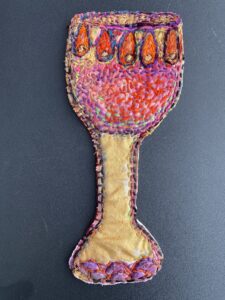
  • In Eve I Understand, Santa Fe-based fabric artist Ellie Beth Scott engages in a visual interpretation of objects and subject matter in Jewish life with an emphasis on women, who like Eve, the first Woman of Valor, perpetuate devotion and determination in a myriad of ways. Inspired by selected works in the Skirball collection used by women and by practices performed by women, Scott renders richly colored pieces using fabric, thread, paint, buttons, and beads. This exhibition closes on February 4, 2024.
  •  In celebration of Israel at 75, ish, whose mission is to create intentional spaces for connection and acceptance through the arts and new-ish rituals rooted in Jewish cultural traditions, brings together four Israeli artists and four Cincinnati artists who each create an original work of art and four additional works that interpret and “re-art” the work of their colleagues. The works respond to the power of women as community builders, organizers, and healers through times of crisis and change. This exhibition closes on February 4, 2024.
  • After a lengthy closure caused by supply chain issues during the COVID-19 pandemic, the galleries devoted to Torah, Life Cycle, and Holidays and Festivals in the Skirball’s core collection, An Eternal People: The Jewish Experience, are once again open with new cases, new signage, and ritual objects from the B’nai B’rith Klutznick Collection that have never been on view before. Old favorites are seen in a whole new light, literally and figuratively. This grand reopening is made even more meaningful by the opportunity to bring Ellie Beth Scott’s discerning eye to several objects of material culture displayed in these newly installed galleries and other parts of the Skirball’s core collection. 

The Skirball is open Tuesdays and Thursdays, 11 am to 3 pm and Sundays, 1 to 4 pm, or by appointment. Contact awheeler@huc.edu, call 513.487.3231, or visit our website, https://csm.huc.edu.

Categories
Cincinnati Citizenship Interreligious study Religion

6th Annual Cincinnati Festival of Faiths

By Chip Harrod
 
Cincinnati, Ohio – In the afternoon of Sunday, August 27th, nearly 2,000 people came together to learn more about and celebrate our community’s rich religious diversity.  They did so as participants in EquaSion’s 6th Annual Cincinnati Festival of Faiths, held at Xavier’s Cintas Center.


That “religious diversity” took the form of three dozen faith traditions representing 14 world religions contributing to the Festival’s amazing array of exhibitors, vendors, sponsors, and program participants.  Imagine a trade show-like exhibition of religious and faith-based groups, more than 70 of them, manning table displays sharing information about their organization to interested attendees.  “What are your beliefs, how do you worship, how do you celebrate your major holidays?”


The customary opening of the Festival was again an Interfaith Devotional Observance in which numerous spiritual leaders offered prayers on the Festival’s theme of “Compassion through Action:  Dwelling Together in Peace and Justice.”   Complementing the dynamic floor exhibition were a diverse group of ethnic entertainers performing throughout the afternoon, a children’s “Peace, Love, Play” area, three engaging sessions related to EquaSion’s on-going programs (Faith Communities Go Green, A Mighty Stream racial justice initiative, and Compassionate Conversations), and to the culinary delight of the attendees free food prepared and served, once again, by our Sikh community.


Mayor Aftab Pureval offered greetings from the City of Cincinnati and Vice Mayor Jan-Michele Lemon Kearney served as a celebrity emcee.


This year’s Festival continued beyond the initial exhibition with on-line programming the following three days culminating in a first ever interfaith Peace Walk in Ault Park on the evening of August 31st.


Presiding over Festival Week and serving as Honorary Co-Chairs were Archbishop Dennis Schnurr, Rabbi Gary Zola, Achary Kailash Sharma, and Shakila Ahmad.  The Festival’s co-managers were Afreen Asif and Jan Armstrong Cobb.  All of the events of the Festival were designed, organized, and presented by EquaSion’s interfaith team of volunteers.


To learn more about this year’s Festival of Faiths go to the EquaSion website at https://equasion.org/festival-of-faiths/interfaith-celebration/.


EquaSion is a non-profit civic organization grounded in interfaith dialogue that works to promote an inclusive, equitable, compassionate, and just community for everyone.
Categories
Environment Front Page

Department of Energy Grant for Regional Faith Communities

In June the Department of Energy announced a new pilot grant program for nonprofits entitled “Renew America’s Nonprofits.” The Renew America’s Nonprofits program—referred to in President Biden’s Bipartisan Infrastructure Law as the Energy Efficiency Materials Pilot Program—will reduce carbon emissions, improve health and safety, and lower utilities costs at buildings owned and operated by 501(c)(3) nonprofits, allowing critical funds to be redirected to mission-focused work. This grant was announced in our last newsletter.

Faith Communities Go Green, a collaborative project between Green Umbrella, the premiere regional environmental collective action nonprofit and EquaSion, the premiere Interfaith nonprofit, assembled a team to attempt to collect all of the information and resources to apply for the grant. The plan was to distribute up to $200,000 each to diverse faith communities that own their own buildings to increase energy efficiency. The larger vision was that this would not only benefit the faith communities by saving money but also impact the communities which they serve.

The Biden administration has initiated a new dimension for many of their federal grant programs called Justice 40 Initiative. Quoting from that initiative: “For the first time in our nation’s history, the Federal Government has made it a goal that 40 percent of the overall benefits of certain Federal investments flow to disadvantaged communities that are marginalized, underserved, and overburdened by pollution.” Our plan was that 80% would be from the designated Justice 40 areas and that 100% of the grant money would have community benefits for the disadvantaged and marginalized communities in our region.

Once the DOE issued the full Funding Opportunity Announcement (FOA) in late June there was less than two months to assemble all the information and to submit the grant which was due on August 3rd . Teams within Green Umbrella and Faith Communities Go Green worked diligently during this period attempting to compile the necessary information as well as working to secure the matching funds necessary (called “cost share” in the FOA). Significant progress was made on a great many fronts. We compiled a list of over 400 faith communities that might be potential candidates to receive the funds. We communicated with a broad range of potential partners who could do the work funded with particular focus on minority and women owned businesses. We contacted numerous organizations who might help with the cost share. And, perhaps most importantly, we began the formulating an overall vision of how a grant such as this might act as a catalyst to use faith communities as conduits that would help educate communities, particularly underserved, disadvantaged communities, about sustainability and to help bring them into the green economy through work force development, energy savings and improved health.

In the end the timeframe given us by the DOE was too short and the informational, administrative and financial requirements were too great. With a little more than a week until the submission deadline for the application, the decision was made by the group that we were not able to submit a grant this year. Ryan Mooney-Bullock, the Executive Director of Green Umbrella has issued a letter to the community, explaining our reasons for not submitting a grant this year but also making it clear that the very productive process we commenced in response to the FOA, will continue with the hope of applying for this next year or for other grants to support this type of work. Here is Mooney-Bullock’s letter to the community:

“Green Umbrella has decided it is not able to reasonably complete a competitive application for the Renew America’s Nonprofits funding opportunity from the Department of Energy. Even with the project team’s extensive efforts, we were not able to pull together all of the details required for the proposal. A huge missing link was commitments for the $750,000 to $1,000,000 in cost share dollars we needed to assure the DOE we could bring to the table. We also recognized the administrative burden the program would place on our organization, and all of the sub-recipients and partners, and did not feel like we could commit the extensive resources needed to comply with all of the requirements laid out in the funding description.

But, this is not the end of this important and growing body of work! We are thrilled with the level of connections, new relationships and opportunities for shared work that have come out of the conversations we have had through this project. We want to keep the momentum going and are in the process of mapping out next steps.

Faith Communities Go Green will be reaching out in the coming weeks with more details on how we can keep this collaborative work moving forward. Some of the specific ideas we have heard that we would love to explore with you are:

    • Hosting an open forum for congregations interested in this work to talk and explore other options for funding, and how they can collaborate with each other to advance shared goals.
    • Finding ways to connect so FCGG can understand your priorities and needs, and better support you in this work moving forward
    • Sharing resources being collected with partners, including women and minority owned businesses that may be good leads for your projects
    • Connecting community members with workforce development and apprenticeship programs in the green economy that lead to family-sustaining jobs
    • Connecting you with other grant funding and financing options to help get your projects completed to improve the performance and usability of your buildings.”

For all of those reading this who would like to join us as we continue this work please contact us at info@fcgg.org.

Categories
Cincinnati Islam Prayer Religion

Eid ul Adha 2023

June 30, 2023

By Samina Sohail, MD

Cincinnati, Ohio — Regionally, approximately 30,000 Muslims gathered across the Tristate to celebrate the annual Eid-ul-Adha holiday this past week.

Eid ul Adha is a religious holiday which coincides with the annual Hajj pilgrimage, whereby Muslims all over the world perform one of Islam’s five pillars of faith.  This year around 2.5 million Muslims gathered in Mecca, Saudi Arabia for the Hajj.

Eid ul Adha also memorializes Prophet Abraham’s exemplary demonstration of obedience to God by his willingness to sacrifice his son following God’s command. God subsequently replaced Abraham’s son with a sheep for the sacrifice.  Muslims globally commemorate this devotion to God with the sacrifice of sheep, cows, or goats. A portion of this meat is then distributed to the poor.  As such, this holiday exemplifies mercy, obedience, sacrifice, and service to others.
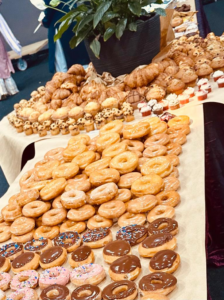
Eid ul Adha  is one of the two holiest celebrations for Muslims.  The other is Eid ul Fitr which occurs at the conclusion of the month of fasting, Ramadan.

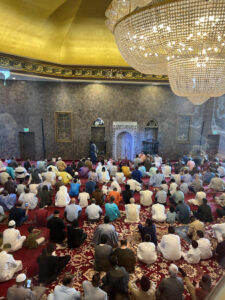
On the morning of Wednesday, June 28, 2023, the Islamic Center of Greater Cincinnati hosted about 5,000 Muslim Americans for congregational prayers.  Muslims from diverse backgrounds gathered to pray, hear a sermon with words of inspiration, and A table is laid with a variety of donuts and sweet pastries, ready to celebrate Eid. share tasty snacks.  The morning was marked by a colorful array of diverse ethnic attire, warm greetings, hugs, and joy. Since most Muslims are able to take the day off on Eid, the rest of the day is spent gathering with friends and families, gift exchanges, and scrumptious feasts of biryani, kabobs, koshary, kabsa, sambosas, grilled meats, burgers, along with treats such as baklava, kanafeh, sheer korma, halwa, donuts, pastries and more.

Locally Muslims also left their celebratory footprint throughout the city with their presence at local cafes, restaurants, Graeter’s, and even King’s Island.