Categories
Cincinnati History LGBTQ+

Multifaith Pride Service Continues Local Tradition

Cincinnati, Ohio – For nearly four decades, religious communities from around Cincinnati and Northern Kentucky have come together to pray together and celebrate Pride. The first such event was held in 1986 at All Saints Chapel, a faith community which met at Pilgrims Chapel, on Ida Street in Mt. Adams, and ministered especially queer folks. Though this congregation no longer exists, its legacy lives on in what has become an annual celebration of the Pride Multifaith Service.

Michael Chanak Jr., then a leader of All Saints Chapel, spoke at the very first multifaith Pride celebration. He recalls, “surprisingly, even in 1986 it was well attended…. the service gave another venue where LGBT folks could come together.” For many years, this interfaith group was also part of the Pride committee, supporting and being supported by the wider celebration of Pride in the region.

Today, this service has grown to include members of numerous faith traditions and denominations. More than 40 people have been part of the event planning, this year alone. And over the years, a wide variety of artists have contributed music, including but not limited to the Cincinnati Men’s Chorus, Muse, the Cincinnati Women’s Choir, and Vox Veritatis.

What began as a prayer service has become an opportunity for spiritual inspiration and action. Folx can come for the spiritual nourishment and stay for a social that takes place after the event, where there are catered treats and organizations representing LGBTQ issues host tables to invite community engagement and connection.

This year, the theme of the Multifaith Pride Service is “Embracing Divine Diversity.” Rev. Derek Terry, Program Director for the Open and Affirming Coalition, a national nonprofit in covenant with the United Church of Christ, will be the guest speaker. First United Church of Christ, 5808 Glenview Ave Cincinnati, OH, 45224, will be hosting the event on Thursday June 26th. Doors will open at 6:30, and the service will begin at 7pm.

LGBTQ organizations and Allies that wish to table or help sponsor the event are welcome. Inquiries should be made to Becca Desai at bfdesai@aol.com.

Whether you have long been part of this multifaith service or this year’s celebration becomes the first time you pray with Pride, all are welcome. As organizers put it, “We are stronger together united for LOVE! The Multifaith Community of Cincinnati and NKY is here to help faith/belief systems not only coexist, but to come together in unity through compassion, acceptance, kindness, and above all else LOVE!!!”

NOTE: in an earlier version of this article, the final quote was incorrectly attributed to Rev. MiMi Chamberlin.

Categories
Christianity Cincinnati Immigration Prayer

A Good Friday in Cincinnati

By: Kathleen Sellers

Cincinnati, OH – Each year, two days before Easter Sunday, Christians around the world commemorate Good Friday, the day on which Jesus is believed to have been crucified, died, and buried. While many Christians call this day “good,” because it commemorates the essential step toward Jesus’ resurrection from death and conquering of sin, it is a very somber day, a time to remember (and repent from) human sinfulness and the structures of injustice through which we contribute to the suffering of others.

Traditionally, many Christians will attend a  prayer service on this day, during which the story of Jesus’s suffering and death will be recounted. That story includes a painful journey, in which Jesus was forced to carry his own cross, the weapon of his execution, up to the top of Calvary, the hill where he was then publicly executed by his Roman captors.

For Christians in Cincinnati, though, this is not just a day of somber prayer but also one of pilgrimage. For more than a century and a half, Catholics have been coming to “The Steps” in Mt. Adams, to commemorate Good Friday. Starting just before midnight, people will gather along St. Gregory street, below Holy Cross Immaculata Church, waiting to pray their way to the crucifix, which stands outside the entrance to the church. This line would persist throughout the 24 hours of Good Friday, a constant remembrance of Jesus’ own journey up Calvary.

As a child, I remember waiting in line with my mother and a small group of fellow Catholics, as the pastor of Immaculata blessed The Steps at midnight and then led us in praying the rosary, one prayer on each step, as we gradually ascended the hillside toward the church. This was a ritual I knew well. My mother had come to The Steps with her mother in the 1960s, a journey that brought them by train from Eastern Kentucky into the big city of Cincinnati. I never had the chance to meet that grandmother before she died, but I always felt closer to her on Good Friday, as I walked the steps with my mom, knowing this pilgrimage was a tradition we shared.

This year, thousands of pilgrims made their way, again, to Mt. Adams. As I turned onto St. Gregory Street, a few minutes before midnight, I was surprised to see a large crowd was already gathered, filling the sidewalk for a block in both directions, waiting for the blessing of The Steps to mark the start of the pilgrim ascent. Normally, the volume of pilgrims begins as a trickle at midnight and swells mid-day on Friday, from 12-3pm, during the traditional window when Jesus is belived to have hung on the cross. This evening, though, several hundred, at least, were waiting patiently, perhaps drawn by the presence of the new Archbishop of Cincinnati, Robert G. Casey, who was appointed by Pope Francis in February of this year. Archbishop Casey, fresh off his installation mass a week prior, led the blessing of The Steps, before joining the faithful, climbing The Steps behind a young clergyman, who led the people in praying the rosary, as the crowd made its way, one Hail Mary at a time, up the hillside. 

Twelve hours later, Catholic pilgrims were still climbing The Steps, as an ecumenical group of Christians gathered in Smale Park, to walk The Way of the Cross for Justice. Since the 1980s, this prayer service has brought together a wide variety of faith-based organizations and religious communities to commemorate Good Friday through, according to event sponsor Ignite Peace, intentionally “connecting the suffering of Jesus with the suffering brought about by injustice in our day.”  This year’s prayer service focused on the struggles faced by the immigrant community in Cincinnati. Several religious congregations and communities contributed to the walking prayer service, reflecting in stages about the different struggles faced by immigrants – from access to healthcare to freedom from political oppression. At each “station,” lay and ordained faith leaders shared testimony about the kinds of ministries they engage in and reminded the faithful of the many tangible ways that they could likewise support outreach to immigrants. 

This invitation was especially prescient this year, as immigrants have been targeted by the current Presidential Administration, which has rescinded policies that honor the sanctuary religious congregations have long offered immigrants. So concerning are these times that even Pope Francis, may he rest in peace, spent some of his last days advocating for the wellbeing of migrants in the United States. On February 10, 2025, he wrote to US Bishops, to remind them that Jesus was “expelled from his own land because of an imminent risk to his life, and… [took] refuge in a society and a culture foreign to his own” and to “exhort all the faithful of the Catholic Church, and all men and women of good will, not to give in to narratives that discriminate against and cause unnecessary suffering to our migrant and refugee brothers and sisters. With charity and clarity we are all called to live in solidarity and fraternity, to build bridges that bring us ever closer together”. 

As members of numerous generations, denominations, cultures, and countries prayed together– walking as pilgrims up The Steps and along the Ohio River–it was truly a Good Friday to remember who we are, neighbors united in love for God and one another.

Categories
Cincinnati Front Page Interreligious study Judaism Religious Practice

Come to the Table: Why AJC’s Community Intergroup Seder Matters

On Tuesday, April 8, 2025, AJC Cincinnati will proudly host its 32nd Annual Community Intergroup Seder, a cherished gathering and cultural experience for local community members and leaders of diverse backgrounds. Led by Rabbi Matthew Kraus, this gathering is more than just a commemoration of Passover—it is an opportunity to foster reflection and understanding in a time when our world needs it most.

Passover is one of the most significant holidays in Jewish tradition. It marks the Israelites’ journey from enslavement in Egypt to freedom, a story deeply embedded in Jewish history and identity. The Seder, a ritual meal held during Passover, is structured with prayers, symbolic foods, and storytelling, guiding participants through the timeless themes of hardship, resilience, and liberation.

However, the Seder transcends religious boundaries. Its core themes—freedom, justice, and the pursuit of a better world—resonate universally, making it an event that people from all walks of life can connect with on a deeply personal level. By attending the Community Intergroup Seder, participants engage in a shared experience that fosters dialogue, mutual understanding, and a renewed commitment to building a more inclusive society.

With global conflicts, domestic divisions, and rising societal challenges, the importance of community events that emphasize shared understanding cannot be overstated. The AJC Cincinnati Community Intergroup Seder serves as a reminder that freedom and justice are not static achievements, but ongoing pursuits. It also provides a space where people can step away from daily struggles and come together in a spirit of solidarity and hope.

This year’s Seder will be particularly special, featuring personal narratives from community members and leaders who bring unique perspectives to the evening’s discussions. Attendees will hear from individuals involved in the immigrant and criminal justice spaces, as well as guests from Israel who will share their own reflections on the Seder’s themes and help deepen the Seder experience, transforming it from a historical commemoration into a relevant and urgent conversation.

As we quickly approach April 8, 2025, consider taking part in this extraordinary event. The AJC Cincinnati’s 32nd Annual Community Intergroup Seder is more than a delicious lunch from Café Alma or a ritual; it is a powerful reminder of the importance of history, storytelling, and collective action. In a world that often feels divided, this Seder offers a chance to come together, listen, learn, and reaffirm our shared humanity.

If you would like to attend, please REGISTER HERE by April 3rd.

Categories
Art Cincinnati Religion

An Engaging Evening of Faith, Culture, and Community at the Interfaith Center Open House

Oxford, Ohio — On Monday, February 17th, the Interfaith Center hosted an Open House that brought together individuals from different backgrounds to explore faith, identity, and culture. The event included a photography exhibition, performances, and discussions, providing attendees with opportunities to learn and connect.

The keynote event was Abayudaya: The Jews of Eastern Uganda, a photography exhibit and art talk that highlighted the lives of the Abayudaya Jewish community in Namutumba, Uganda. This community has practiced Judaism for over a century in a predominantly Christian and Muslim region. The exhibit featured images documenting the arrival of the community’s first kosher Torah and their traditions. This visual intercultural immersion encouraged reflection on Jewish identity and the intersection of religion, ethnicity, and culture. Guest speaker Samantha Mandeles, a researcher, artist, and advocate for African Jewish communities, led the discussion, providing thoughtful insights into the themes of the exhibit and the broader context of interfaith dialogue.

Attendees also explored informational tables and interactive activities hosted by local community, campus, and student organizations, including the event’s co-sponsors: the META Collective, Ezra Uganda Assistance, OCPJ, Hillel at Miami University, Wesley Campus Ministry, Holy Trinity Episcopal Church, and Oxford Presbyterian Church.The evening included live music by Judy and Warren Waldron and a dance performance by the Gajdi Jawani co-ed Bhangra team. Food and drinks were available, creating a welcoming environment for conversation and networking.

The Interfaith Center Open House provided a space for participants to engage with diverse traditions and perspectives. Attendees left with a broader understanding of global faith communities and interfaith connections.

For more information about the Abayudaya Jewish community and the work of Ezra Uganda Assistance, please visit their webpage: https://www.ezrauganda.org/

Categories
Cincinnati Environment

Faith Communities Engage in Energy Efficiency Initiative

By Joanne Gerson | February 27, 2025

Cincinnati, Ohio — When we asked for volunteers to help with the Energy Efficiency Initiative (EEI), sixteen people gave the gift of time and energy by taking 4 all day classes to learn how to conduct Level 1 Energy Assessments. They shared their acquired gift of knowledge with ten EEI houses of worship, submitted written reports detailing how to lower the cost of utility bills, reduce polluting emissions, and create more comfortable buildings. Many recommendations can be performed by congregational members for little or no cost.

Ohio offers nonprofit’s grant opportunities to cover the cost of expensive energy efficiency improvements and Level 2 Energy Audits. An energy company offered to complete Level 2 Energy Audits for seven houses of worship facilities at a very low price, in part because of the accurate and well documented Level 1 Energy Assessments reports by the volunteers.  Generous donations from Co-op Cincy and The Bruegguman Center paid for seven Level 2 Energy Audits.  Armed with the Level 2 audits, the houses of worship can now apply for state grants to pay for recommended upgrades. If the houses of worship receive the grant awards, they can focus on creating a more resilient community with money saved by providing cooling centers during extreme heat events, or opening food pantries, or organizing programs for troubled teens, and so on.

To participate in the Energy Efficiency Initiative, complete the Survey found on the Facilities working group page HERE.  [https://fcgg.org/facilities/ ]

To learn more and join Faith Communities Go Green,
a Green Umbrella & EquaSion Collaboration, go to 
FCGG.org
Your donations support our programs,  Donate today,

Categories
Cincinnati Environment Ethics Front Page

Faith Communities Mark Another Year of Going Green

By: Joanne Gerson

Thank you for your engagement in Faith Communities Go Green in 2024!
Thank you for volunteering, presenting your knowledge in FCGG webinars, working at our booths, contributing articles in our newsletters, writing letters to Ohio Legislators, participating in our new Energy Efficiency Initiative, and generously donating to FCGG.
Because of you, we achieved so much in 2024 to make our world better.

We proudly announce the 2024 Annual Report, available on our website, FCGG.org
https://fcgg.org/wp-content/uploads/2025/01/2024-Annual-Report-1-final-.pdf  

To create a more sustainable and equitable future for all, Faith Communities Go Green educates, engages, and empowers people of faith to reduce the risk of catastrophic climate change, its impact on Greater Cincinnati and the world. But the gates of opportunity are closing for society to reverse or slow climate change. Now, more than ever, in 2025, hope lies in mobilizing the moral voice of faith communities to unite, to lead by example, to reinforce the message found in all faiths: Care for Creation, Mother Earth , our Common Home, to leave a sustainable and equitable future for all.

We no longer have normal weather. Instead, we have NOT normal fires during a NOT normal fire season; we have NOT normal hurricanes in NOT normal places; we have NOT normal heat waves for NOT normal consecutive days; we have NOT normal floods and NOT normal droughts, all in NOT normal strength, length, and locations.

Climate change is here. Like tipping your chair, you can easily tip it back to the normal position unless you tip it too far, causing it to land flat on the floor. Climate systems have tipping points too. If we push our luck too far, the earth’s climate will reach a tipping point, and we will not be able to return it back to normal. We are fast approaching these tipping points. It’s not too late to act.

What can you do?  Start with our FCGG.org  website. For example:

 The best thing to do is to Join Us through the Faith Communities Go Green website: FCGG.org and click the Join Us Tab.  [https://fcgg.org/fcgg-interest-form/]

Categories
Cincinnati Front Page Homelessness Service

The Greater Cincinnati Homeless Coalition Celebrates 40 Years of Advocacy and Empathy

Cincinnati, Ohio — The Greater Cincinnati Homeless Coalition is a unified social action agency, committed to eradicating homelessness and respecting the dignity and diversity of people experiencing homelessness. For forty years, since 1984, they have worked toward this mission by coordinating services, educating the public, and engaging in grassroots organizing and advocacy.

This mission serves an essential and urgent need in the region because from 2023 to 2024, we have seen the largest increase, in a decade, in people living outdoors, and the gap between the number of people needing affordable housing and the amount of affordable housing available has increased greatly.  Far too many people are experiencing the trauma of homelessness.

Despite this, the Greater Cincinnati Homeless Coalition has pushed forward, because we know it doesn’t have to be this way.  This year, we’ve been able to:

  • Organize with tenants of properties in more than 2,300 homes and more than 5,000 people. This has resulted in hundreds of saved homes, improved living conditions, and the removal of health hazards.
  • Provide education to more than 1,500 people, building empathy and deepening their understanding of the causes of homelessness and the solutions to it.
  • Reach a historic settlement with the City of Cincinnati that has the power to begin shifting the response to homelessness from criminalization to care.

The Homeless Coalition has also marked this 40th year of serving Cincinnati by organizing a prayer service for Homeless Memorial Day and hosting a celebratory event in OTR, both in December 2024.

We have so much more to do, and we anticipate some of our work may become more difficult. But homelessness is not inevitable; it is a problem that we solve. With your continued partnership, we can realize a future where no one has to endure the trauma of homelessness.

If you would like to learn more about the Greater Cincinnati Homeless Coalition and ways to support their mission and build a stronger, more empathetic Greater Cincinnati, please visit their website at: https://cincihomeless.org/

Categories
Cincinnati Environment

Your involvement helps Faith Community’s FACILITES

Under Ken Wright’s leadership, seventy faith communities completed Faith Communities Go Green’s survey to participate in our Energy Efficiency Initiative (EEI) that kicked off January 8th , 2024. Forty percent of the EEI participants represent underserved minority communities. Under the Biden administration, federal grant applications require 40% of grant applicants come from underserved minority communities which are identified on the Federal “J40” map (“J” for Justice and “40” for the required 40% on federal grants). The City of Cincinnati included ten J40 FCGG Houses of Worship on their grant application. Through the work by Ken and his team of volunteers, we learned that these ten Houses of Worship spent an average of $23,700 a year on utility bills, ranging from $5,200 to $53,800. Their energy use averaged 50 kBTU/sq-ft/yr, well above the national average of 30 kBTU/sq-ft/yr reported by the EPA. Our ten J40 Houses of Worship energy use ranged from 30 to 70 kBTU/sq-ft/yr.

Though the City was not awarded the grant, we developed recommend energy efficiency improvements for each house of worship. Many of these projects can be done themselves, but some would require hiring a contractor. Energy efficiency improvements result in lower utility bills and reduced CO2 emission that will protect the planet’s climate.

We are working with the director of CoopCincy to be ready to apply for grants coming available in January 2025 through the State of Ohio. Federal grant money is given in block form to each State. We hope to have at least 25 Ohio Houses of Worship ready with completed audits to define needed projects and financial support in grant applications. Some of these grant opportunities will require ASHRAE Level 2 audits.

Your donations will help these Houses of Worship pay for an ASHRAE Level 2 audit. Please send your questions to Ken at facilities@fcgg.org

Categories
Citizenship

Reader Opinion: Issue One

By: Ariel Miller

YES on Issue 1, urge the Ohio Council of Churches and many other faith-based groups. Don’t let the misleading ballot summary confuse you. Ohio’s current Congressional and state districts were created by a Redistricting Commission entirely composed of elected officials, who used their authority in 2021-22 to produce a supermajority in our statehouse and our US House delegation far exceeding the majority party’s share of statewide votes. When legislators create “safe” districts to preserve their power, they can ignore the views of the majority of Ohioans on issues like racial equity and gun safety, and can instead play to lobbyists and ideological base voters.  In an uncompetitive district, the minority who vote in primaries determine the election outcome. Moderate candidates are often eliminated in primaries if their views don’t please the ideological base in their district.

To prevent conflict of interest, the Issue 1 “Citizens not Politicians” amendment proposed for Ohio’s constitution would ban elected officials and lobbyists from serving on Ohio’s Redistricting Commission. Supporters including many people of faith collected over 500,000 valid signatures to qualify Issue 1 for the November ballot. The amendment would require a public, transparent process to produce district maps.  The ballot summary – written by elected officials on the Ohio Ballot Board – misleads voters by stating that the reform would “require” rather than prevent gerrymandering.

The failure of our legislature to represent Ohioans shows up in two key concerns for many judicatories: racial justice and gun safety.  The 2024 Ohio Pulse Poll just released by Baldwin Wallace University shows that 84.3% of Ohio voters support teaching about the history of race and racism in Ohio schools, a significant increase from 75% in 2022!  That includes 84.2% of Ohio parents. But the Ohio Legislature has stripped the Ohio School Board of its authority over curriculum, after a titanic battle following the School Board’s 2020 resolution to work on overcoming systemic racism documented in a study of 600 school districts. SB 83, if passed, would virtually eliminate diversity, equity and inclusion from Ohio’s public universities and curtail teaching about “divisive content” on topics including race and climate change.

Gun violence is the leading cause of death for American children and teens. Ohio voters overwhelmingly support stronger gun safety laws including red flag laws (73.4%) and expanding background checks for gun purchases by people 18-21 (85.6%).  Only 38.5% support permitless conceal-carry, but our legislature passed a law eliminating the training and permit requirement for conceal-carry, and has stalled bills to close loopholes in background checks, or to enact red flag options to temporarily remove guns from people who pose a danger to themselves or others.

Endorsers of Issue 1 include Ohio’s chapters of the League of Women Voters, the NAACP, and the A. Philip Randolph Institute, the Amos Project, Faith in Public Life, the Episcopal Diocese of Southern Ohio, the Hunger Network of Ohio (a Christian advocacy nonprofit), the National Council of Jewish Women of Cleveland, the Woman’s City Club, and many other statewide and regional nonpartisan groups.

Just know that a Yes vote establishes the nonpartisan commission and a No vote keeps the current process in place,” wrote the Ohio Council of Churches in their Oct. 10 newsletter. “Please spread the word to your friends, family, and faith communities to vote Yes on Issue 1 this election. The Council has worked tirelessly with our faith, civic, and community partners since 2015 to ensure that legislative maps in Ohio are drawn fairly…We believe voters should choose their representation, not the other way around.  We witnessed last year the refusal of the current redistricting commission to obey the very laws they swore to uphold when they drew unfair maps not once, not twice, but seven times. Issue 1 is designed to correct this miscarriage of justice by replacing the current commission made up of elected officials.”

The Citizens Not Politicians amendment was drafted by a team of Republican, Democratic, and Independent Ohio civic leaders including former Ohio Supreme Court Chief Justice Maureen O’Connor, a lifelong Republican and former Lieutenant Governor who wrote or signed all seven rulings finding the 2021-22 maps unconstitutional for providing excessive partisan advantage under the criteria approved by voters in 2015 and 2018 amendments to the Constitution, which specified that all members of the Redistricting Commission be current elected officials.

For more background on state policy trends on issues including energy policy, contact Ariel at arielmillerwriter@gmail.com

Ariel Miller is the Advocacy Co-Chair, Faith Communities Go Green, a collaboration of Green Umbrella and EquaSion.

Categories
Citizenship Liberal Democracy National Identity

Voter Information

Election day is Tuesday, November 5th!

We have gathered everything you need to know about voting in the 2024 primary election. The details below are for Hamilton County. If you live in a different county, click here to check for your county’s details.

Note: Remember to bring a valid photo ID with you to vote. For details on what qualifies as a valid photo ID, click here.

Thank you for exercising your constitutional right and voting!

Check Your Registration

In order to vote in Ohio, you must be registered. You can check your registration status here.
View Your Sample Ballot

To help you prepare for the election, you can look up your sample ballot here. This will show you what the actual ballot looks like, including candidates, questions, and instructions for voting.

Voter Education
The League of Women Voters free, non-partisan Voter Guide, covering state and local issues along with local elections, is ready to distribute. Visit Vote411.org to see your sample ballot and voter guide.
Find Your Polling Location

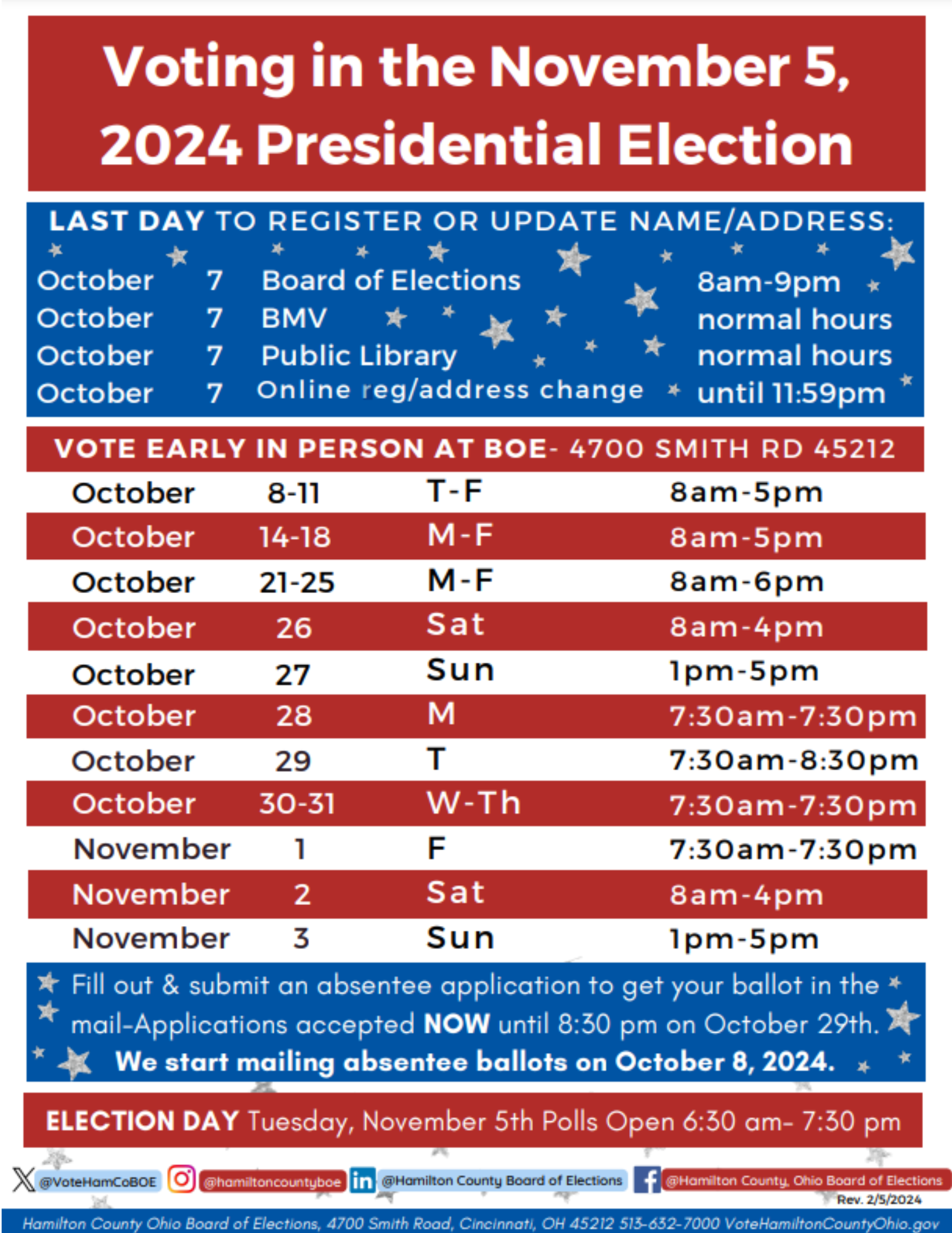
Election day is Tuesday, November 5th. You can look up your polling location here. Polls are open from 6:30 AM until 7:30 PM.

Early Voting Options
Early voting is a great option to submit your ballot when it works for your schedule.

  • Vote in-person before election day
    Early in-person voting takes place ONLY at
    The Board of Elections Office
    4700 Smith Road, Cincinnati, OH 45212  

    See below for dates and times.
  • Vote by mail 
    All Ohio voters whose registration information is up-to-date have the opportunity to vote in any election from the convenience of their own homes by requesting an absentee ballot.
    Learn more here.

Free Rides to Vote
If you know of anyone experiencing transportation or accessibility issues, please have them reach out to the Greater Cincinnati Voter Collaborative and its partner, RideShare2Vote Aware, to get a free round-trip ride to vote during early voting and on election day. Click here to schedule a ride or call 888.858.3421. Please spread the word.

Election Protection Info
The national, nonpartisan Election Protection coalition works year-round to ensure that all voters have an equal opportunity to vote and have that vote count. Click here to learn more about the Election Protection effort.

Reprinted with permission from EquaSion.